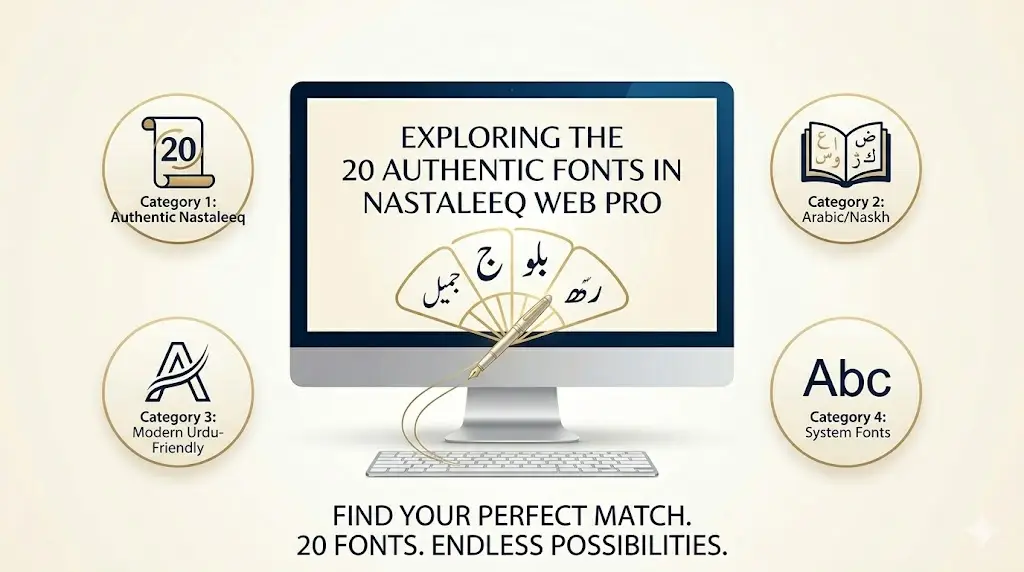
Exploring the 20 Authentic Fonts in Nastaleeq Web Pro
Introduction
One of the most powerful features of Nastaleeq Web Pro is choice. Unlike other Urdu typography tools that limit you to one or two generic fonts, Nastaleeq Web Pro puts twenty carefully curated fonts at your fingertips. Each font has its own unique personality, history, and visual character. Each one can dramatically change how your audience perceives your content.
But with so many options, where do you start? Which font is best for poetry? Which one should you use for educational materials? What is the difference between Jameel Noori Nastaleeq and Noto Nastaliq Urdu?
As we explored in our beginner’s guide, choosing the right font is essential for professional results. In this ninth post of our launch series, I will take you on a deep dive into all twenty fonts available in Nastaleeq Web Pro. By the end of this post, you will know exactly which font to choose for every project.
Category 1: Authentic Nastaleeq Fonts (Urdu Script)
These five fonts represent the heart and soul of Nastaleeq Web Pro. They are authentic, calligraphic, and deeply connected to centuries of Urdu literary tradition. As we detailed in our post about the struggle of writing Urdu online, authentic Nastaleeq fonts have historically been difficult to render online. Our team has solved that problem.
1. Jameel Noori Nastaleeq
The classic standard for Urdu publishing.
Jameel Noori Nastaleeq is arguably the most recognized Nastaleeq font in the world. It has been used by major Urdu newspapers, literary magazines, and publishing houses for decades. The letterforms are elegant, balanced, and highly readable.
Best for: Newspapers, long-form articles, books, and professional publications.
Character: Authoritative, traditional, trusted.
Pro tip: Use this font for body text in serious or formal Urdu content.
2. Jameel Noori Nastaleeq Kasheeda
Extended spacing with flowing connections.
This variant of Jameel Noori adds kasheeda (extended spacing) between letters. The result is a more open, airy appearance that can improve readability at smaller sizes.
Best for: Educational materials, children’s books, and content where clarity is paramount.
Character: Open, accessible, friendly.
Pro tip: Pair this font with larger line spacing for maximum readability.
3. Alvi Nastaleeq
Elegant and refined, perfect for poetic works.
Alvi Nastaleeq has a distinctive elegance that makes it particularly well-suited for Urdu poetry. The descenders are more pronounced, the curves more flowing, and the overall impression is one of artistic sophistication.
Best for: Poetry collections, literary journals, wedding invitations, and artistic projects.
Character: Elegant, artistic, sophisticated.
Pro tip: Use this font for single verses or short poems where visual impact matters.
As noted in our Nastaleeq vs Naskh comparison, choosing an authentic Nastaleeq font like Alvi signals cultural authenticity and respect for literary tradition.
4. Pak Nastaleeq
Traditional and timeless, ideal for formal documents.
Pak Nastaleeq has a more formal, structured appearance than other Nastaleeq fonts. It is particularly well-suited for official documents, certificates, and formal announcements.
Best for: Government documents, certificates, formal letters, and legal content.
Character: Formal, official, trustworthy.
Pro tip: Combine with medium font weight (500-600) for optimal legibility.
5. Noto Nastaliq Urdu
Google’s modern, clean, and highly reliable Nastaleeq font.
Noto Nastaliq Urdu is Google’s entry into the world of authentic Nastaleeq typography. It is designed to be highly legible on digital screens and works reliably across all modern browsers and operating systems.
Best for: Websites, blogs, digital publications, and any content where cross-platform consistency is critical.
Character: Modern, clean, reliable.
Pro tip: This is the safest choice for web content where you cannot control your audience’s device.
Category 2: Arabic/Naskh Fonts (Excellent Urdu Support)
These fonts use the Naskh script but provide excellent support for Urdu characters. As we explained in our post about solving real problems, having reliable Naskh options ensures your text is always readable, even on older devices.
6. Scheherazade New
A beautiful Naskh font named after the legendary storyteller.
Scheherazade New is elegant, highly readable, and named after the legendary storyteller of One Thousand and One Nights. It is perfect for long-form reading.
Best for: Long articles, stories, novels, and educational content.
Character: Storytelling, flowing, engaging.
Pro tip: Use for content that readers will spend significant time with.
7. Amiri
A classical Arabic typeface with excellent Urdu character support.
Amiri is a revival of the beautiful typefaces used in early Arabic printing. It has a classical, almost historical feel while maintaining excellent legibility.
Best for: Historical content, classical literature, and academic publications.
Character: Classical, scholarly, distinguished.
Pro tip: Pair with serif body fonts for a consistent vintage aesthetic.
8. Lateef
A clean, readable Naskh font ideal for educational materials.
Lateef is simple, clear, and highly legible. It was designed specifically for educational contexts and works beautifully for young readers or language learners.
Best for: Children’s books, language learning materials, and accessible content.
Character: Clear, simple, educational.
Pro tip: This is an excellent choice for Urdu language learners.
9. Harmattan
Simple and clear, perfect for children’s content and beginners.
Harmattan is named after the West African trade wind. The font is straightforward, with minimal decorative elements. It prioritizes clarity above all else.
Best for: Early readers, signages, and content where simplicity is key.
Character: Minimal, clear, functional.
Pro tip: Use for flashcards, labels, and simple instructional text.
Category 3: Modern Urdu-Friendly Fonts
These contemporary fonts bring a fresh, modern aesthetic to Urdu typography. They are perfect for branding, modern websites, and creative projects.
10. El Messiri
A rounded, contemporary Arabic font that works beautifully for Urdu.
El Messiri has distinctive rounded letterforms that feel friendly and approachable. It is particularly effective for headings and display text.
Best for: Headlines, banners, logos, and friendly, approachable content.
Character: Rounded, friendly, approachable.
Pro tip: Use at larger sizes (36px+) to appreciate the rounded details.
11. Reem Kufi
A bold Kufic style font that makes a strong visual statement.
Reem Kufi is inspired by traditional Kufic calligraphy but adapted for modern screens. It is bold, geometric, and attention-grabbing.
Best for: Headlines, posters, branding, and any content that needs to stand out.
Character: Bold, geometric, strong.
Pro tip: Use sparingly – this font is designed for impact, not long reading.
12. Baloo Bhaijaan 2
A playful, friendly font perfect for children’s content and casual writing.
Baloo Bhaijaan 2 is fun, friendly, and full of personality. The rounded letterforms and playful details make it perfect for casual, joyful content.
Best for: Children’s content, casual blogs, social media graphics, and playful branding.
Character: Playful, friendly, joyful.
Pro tip: Pair with bright colors for maximum cheerful effect.
13. Tajawal
A modern, urban font with clean lines and excellent readability.
Tajawal has a contemporary, urban feel. The clean lines and balanced proportions make it highly readable at both small and large sizes.
Best for: Modern websites, urban branding, and contemporary publications.
Character: Modern, urban, clean.
Pro tip: This font works equally well for headings and body text.
14. Cairo
A versatile, contemporary font suitable for both headings and body text.
Cairo is perhaps the most versatile font in our collection. It is clean, contemporary, and highly legible across all sizes and weights.
Best for: Almost anything – websites, blogs, documents, branding.
Character: Versatile, clean, contemporary.
Pro tip: This is an excellent default choice if you are unsure where to start.
Category 4: System Fonts for Maximum Compatibility
These fonts are pre-installed on most devices. They ensure that your text is always readable, even on older computers or devices that cannot load custom fonts.
15. Traditional Arabic
A Windows system font with reliable Urdu rendering.
Traditional Arabic has been included in Windows operating systems for decades. It is universally available and reliably renders Urdu characters.
Best for: Fallback content, email newsletters, and maximum compatibility scenarios.
Character: Traditional, compatible, safe.
Pro tip: Use as a fallback font in your CSS font stacks.
16. Urdu Typesetting
Microsoft’s dedicated Urdu font, available on most Windows devices.
Urdu Typesetting was specifically designed by Microsoft for Urdu text. It handles Nastaleeq shaping better than most system fonts.
Best for: Windows-focused content and compatibility-critical applications.
Character: Functional, compatible, specialized.
Pro tip: This font is not available on macOS or Linux by default.
17. Microsoft Uighur
Another system font that provides excellent Urdu support.
Microsoft Uighur, despite its name, provides excellent support for Urdu characters. It is another reliable system-level option.
Best for: Fallback scenarios and cross-platform compatibility.
Character: Neutral, compatible, safe.
Pro tip: Include this in your font stack before final fallbacks like Arial.
18. Arial
A universal fallback font ensuring your text is always readable.
Arial is installed on virtually every device in the world. It does not support Nastaleeq shaping, but it will display Urdu characters in a basic Naskh style.
Best for: Ultimate fallback – your text will always be readable, even if not beautiful.
Character: Universal, safe, fallback.
Pro tip: Always include Arial (or another sans-serif) as your final fallback.
Honorable Mentions (Additional Fonts)
19. Faiz Lahori Nastaleeq
A tribute to the legendary poet Faiz Ahmed Faiz.
While not originally in our core twenty, this font deserves mention. Faiz Lahori Nastaleeq has a distinctive poetic character that pays homage to one of Urdu’s greatest poets.
Best for: Poetry collections and literary works.
20. Awami Nastaliq
SIL International’s contribution to open-source Nastaleeq.
Awami Nastaliq is an open-source font from SIL International, the organization behind many linguistic fonts. It is freely available and well-designed.
Best for: Open-source projects and budget-conscious creators.
How to Choose the Right Font
As we discussed in our introductory post, matching your font to your content is essential. Here is a quick decision guide:
| If you are publishing… | Choose… |
|---|---|
| Poetry or literary works | Alvi Nastaleeq, Faiz Lahori, or Awami Nastaliq |
| News articles or books | Jameel Noori Nastaleeq or Pak Nastaleeq |
| Educational materials | Jameel Noori Kasheeda, Lateef, or Harmattan |
| Modern websites or blogs | Noto Nastaliq Urdu, Cairo, or Tajawal |
| Children’s content | Baloo Bhaijaan 2 or Harmattan |
| Headlines and posters | Reem Kufi or El Messiri |
| Maximum compatibility | Traditional Arabic, Urdu Typesetting, or Arial |
Behind the Fonts: The Team’s Curation Process
Our Urdu Language & Font Specialist, Arib Hashmi, personally tested every font in Nastaleeq Web Pro. As you can read in our team introduction post, Arib is a gifted poet himself. He understands that the visual presentation of a verse is just as important as the words themselves.
Each font was evaluated for:
-
Proper OpenType shaping – Do letters connect correctly?
-
Complete character sets – Are all Urdu characters supported?
-
Cross-browser consistency – Does it look the same everywhere?
-
Calligraphic accuracy – Does it honor the Nastaleeq tradition?
Only fonts that passed all four criteria made it into Nastaleeq Web Pro.
Call to Action
Twenty fonts. Endless possibilities. One tool.
Now that you know what each font offers, it is time to experience them for yourself. Visit Nastaleeq Web Pro today. Type something beautiful. Explore every font. Watch how each one transforms your words. Find your perfect match.
Your words deserve the perfect font. Nastaleeq Web Pro has it.
Frequently Asked Questions
Which font is best for Urdu poetry?
For poetry, we recommend Alvi Nastaleeq or Jameel Noori Nastaleeq. Both have the flowing, elegant character that poetic verses demand.
Which font works best on all devices?
Noto Nastaliq Urdu and Cairo are both highly reliable across Windows, macOS, iOS, and Android. For ultimate compatibility, use Traditional Arabic or Arial as fallbacks.
Are these fonts really free?
Yes. All fonts in Nastaleeq Web Pro are properly licensed for web use. The basic version of the tool is completely free.
Will you add more fonts in the future?
Absolutely. We are constantly researching and testing new Nastaleeq fonts online to add to our library.
Can I request a specific font?
Yes. Contact our team through the website. Arib Hashmi personally reviews all font suggestions.
Pingback: How to Copy Web-Ready Code from Nastaleeq Web Pro
Pingback: 1000-Word Limit in Nastaleeq Web Pro Free Version
Pingback: Nastaleeq Web Pro vs Other Urdu Typography Tools
Pingback: How Writers Benefit from Nastaleeq Web Pro