The Struggle of Writing Urdu Online – Why Most Fonts Fail You
Introduction
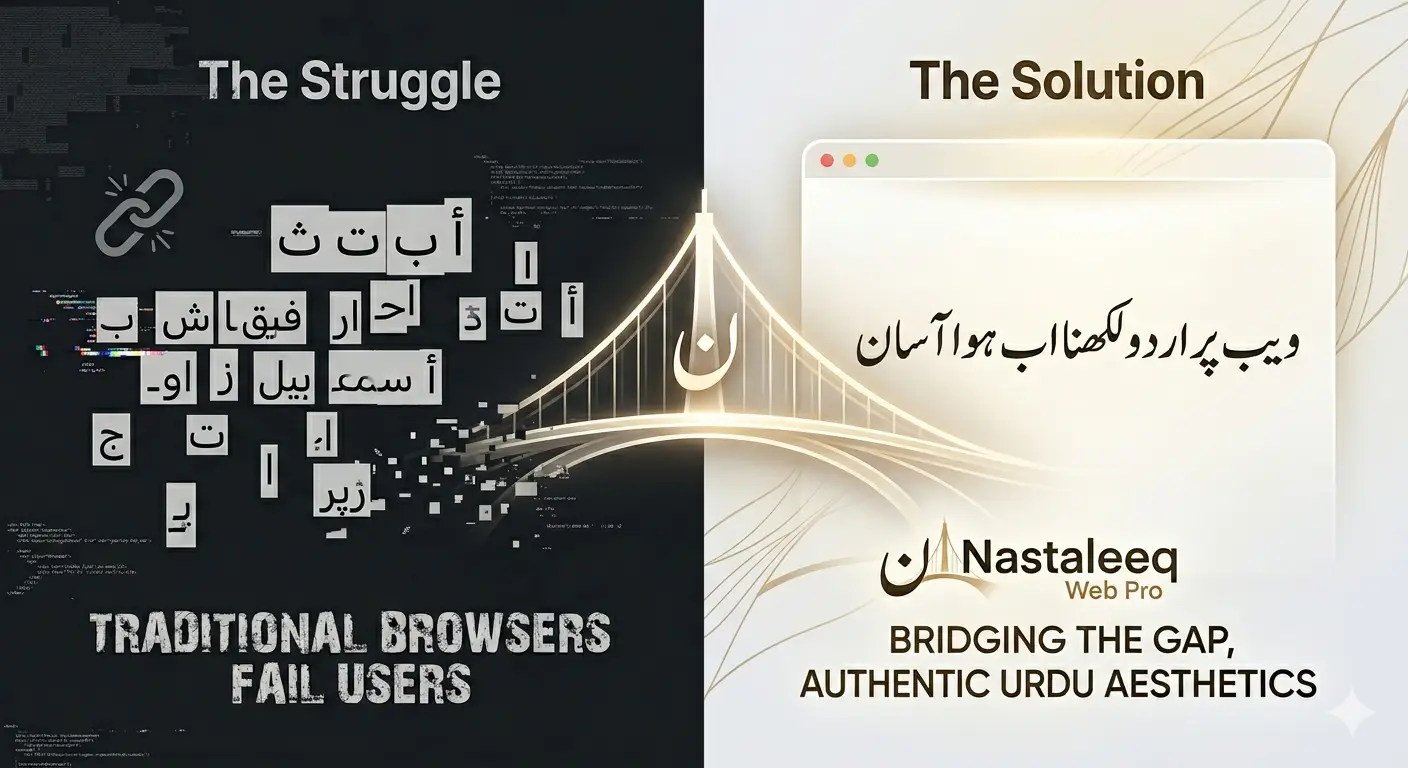
If you have ever tried to publish Urdu content on the web, you already know the pain. You type your words carefully. You select what appears to be a beautiful font. You hit publish with excitement. And then you see it – letters disconnected, words broken apart, diacritical marks floating in the wrong places, and the overall presentation looking unprofessional and embarrassing.
This is the harsh reality that Urdu writers have faced for decades. While English, Arabic, and other major languages have enjoyed seamless digital experiences, the beautiful Nastaleeq script has been left behind. The struggle of writing Urdu online is real, and it affects millions of content creators worldwide.
As we introduced in our first post, Nastaleeq Web Pro was built to end this struggle once and for all. In this fifth post of our launch series, I will explain in detail why most fonts fail Urdu writers online, explore the technical and practical reasons behind this persistent problem, and show you how our Urdu typography tool provides the reliable solution you have been searching for.
The Unique Beauty and Complexity of Nastaleeq
To understand why Nastaleeq fonts online often fail, we must first understand what makes Nastaleeq so special – and so challenging to render digitally.
What is Nastaleeq?
Nastaleeq is a calligraphic script that originated in Persia in the 14th century and was later adopted for writing Urdu, Persian, and other languages. Unlike the more angular Naskh script, Nastaleeq is characterized by:
-
Diagonal baselines – Words flow diagonally downward from right to left
-
Complex ligatures – Letters connect in intricate, context-dependent ways
-
Variable letter shapes – Each letter can have multiple forms depending on its position
-
Overlapping characters – Letters often sit partially inside one another
-
Flourishes and extensions – Descenders and ascenders create a distinctive visual rhythm
These features make Nastaleeq breathtakingly beautiful. When written by a skilled calligrapher, Nastaleeq is considered one of the most elegant scripts in the world. It is the preferred style for Urdu poetry, literature, and formal writing.
However, these same features make Nastaleeq exceptionally difficult to render on digital screens. The story behind our tool began precisely because of this complexity – we realized that existing solutions were simply not equipped to handle authentic Nastaleeq rendering.
The Technical Problem: Why Browsers Struggle
Most modern browsers and operating systems were designed with Latin scripts in mind. Support for complex scripts like Nastaleeq came later – and remains incomplete. Here is why.
1. Lack of Native Nastaleeq Support
Windows, macOS, Linux, iOS, and Android all have varying levels of support for Urdu text. However, true Nastaleeq rendering requires sophisticated shaping engines that most operating systems do not provide out of the box.
Windows includes “Urdu Typesetting” and “Traditional Arabic” fonts, but these are limited in their Nastaleeq support. macOS includes “Noto Nastaliq Urdu” only in recent versions. Many Linux distributions lack any Nastaleeq fonts entirely. This fragmentation means that your beautifully formatted Urdu text on your device may look completely different – and often broken – on someone else’s device.
2. Incomplete OpenType Shaping
Modern fonts use OpenType features to define how letters should connect and shape in different contexts. Nastaleeq requires sophisticated OpenType lookups, ligature substitutions, and contextual positioning. Many fonts marketed as “Urdu fonts” simply do not include these advanced features. They are essentially Arabic Naskh fonts with Urdu character mappings – not true Nastaleeq at all.
When you use such a font, the letters may be technically present, but they will not form the flowing, connected word shapes that define authentic Nastaleeq. The result is a broken, disjointed appearance that immediately signals low quality.
3. Browser Rendering Inconsistencies
Even when a font includes proper Nastaleeq features, different browsers render these features differently. Chrome and Firefox use different shaping engines. Safari on macOS behaves differently from Safari on iOS. What looks perfect in one browser may look completely broken in another.
This inconsistency is a nightmare for content creators. You cannot control which browser your audience uses. Your beautiful Urdu article might look perfect on your Chrome browser but fall apart on your reader’s Safari browser.
Our dedicated team has spent countless hours testing and resolving these browser-specific issues to ensure that Nastaleeq Web Pro delivers consistent results everywhere.
The Font Problem: Why Most “Urdu Fonts” Are Fake
Perhaps the biggest problem facing Urdu writers online is the proliferation of low-quality, mislabeled, or outright fake “Urdu fonts.” Let me explain.
Arabic Fonts Masquerading as Urdu Fonts
Many fonts sold or distributed as “Urdu fonts” are actually Arabic Naskh fonts with Urdu characters mapped onto them. These fonts lack the diagonal baselines, complex ligatures, and overlapping characters that define true Nastaleeq. When you type Urdu text in these fonts, the letters may be individually correct, but they do not flow together properly. The result is readable but ugly – like writing English in a mechanical typewriter instead of beautiful handwriting.
Poorly Converted Calligraphy Fonts
Some developers have attempted to create Nastaleeq fonts by digitizing calligraphy samples. While well-intentioned, these efforts often fail because calligraphy is context-dependent in ways that digital fonts cannot easily replicate. A calligrapher adjusts the shape of each letter based on surrounding letters, the space available, and artistic judgment. A digital font cannot make these dynamic adjustments.
The result is fonts that look beautiful for certain word combinations but break completely for others.
Incomplete Character Sets
Many Urdu fonts only include a subset of the full Urdu character set. They may support common letters but fail on rare characters, diacritical marks, or special ligatures. When your text includes these unsupported characters, the font falls back to a default system font – creating a jarring mix of styles within the same sentence.
Nastaleeq Web Pro uses only fonts that have been professionally designed and tested for full Urdu character support. As announced in our launch post, our library includes twenty authentic fonts, not just the generic options found elsewhere.
The User Experience Problem: Why Writers Give Up
Beyond the technical and font problems, there is a deeper issue: the cumulative frustration drives writers away from publishing Urdu content online.
Time Wasted on Troubleshooting
Urdu writers spend hours, sometimes days, trying to get their text to display correctly. They test different fonts. They try different browsers. They search forums for solutions. They ask friends for recommendations. And after all that effort, they often settle for a suboptimal result – or give up entirely.
This is time that could have been spent writing, creating, and sharing. Every hour spent troubleshooting font issues is an hour stolen from creativity.
Loss of Professional Credibility
For businesses, publishers, and professionals, broken Urdu typography damages credibility. A website with misaligned, disconnected Urdu text looks amateurish and untrustworthy. Readers may question the quality of the content itself based solely on the poor presentation.
The Emotional Toll
Perhaps most importantly, struggling with Urdu typography takes an emotional toll. Writers feel that their language is not respected by the digital world. Poets feel that their carefully crafted verses lose their soul when rendered poorly. Teachers worry that students will find Urdu ugly or difficult based on broken digital presentations.
This emotional toll is exactly what motivated our founder, Hassaan Ahmad Awan, to create Nastaleeq Web Pro. You can read his full story and meet our entire team in our third blog post.
How Nastaleeq Web Pro Solves All These Problems
After understanding the struggles, let me explain how Nastaleeq Web Pro provides the solution that Urdu writers have been waiting for.
1. Carefully Curated Font Library
Nastaleeq Web Pro includes twenty carefully selected fonts that actually work for Urdu text. Our library includes:
-
Authentic Nastaleeq fonts like Jameel Noori Nastaleeq, Alvi Nastaleeq, and Pak Nastaleeq
-
Reliable Naskh fonts like Scheherazade New and Amiri that provide excellent Urdu support
-
Modern fonts like Baloo Bhaijaan 2 and Cairo for contemporary projects
-
System fonts as fallbacks to ensure compatibility on all devices
Every font in Nastaleeq Web Pro has been tested for proper shaping, complete character sets, and cross-browser consistency.
2. Real-Time Live Preview
With Nastaleeq Web Pro, you no longer need to guess how your text will look. The live preview updates instantly as you type, select fonts, and adjust sizes. You see exactly what your audience will see – before you ever publish.
3. Consistent Cross-Browser Rendering
We have tested Nastaleeq Web Pro extensively across Chrome, Firefox, Safari, and Edge on Windows, macOS, iOS, and Android. The code we generate produces consistent results across all these platforms.
4. Web-Ready Code Generation
With one click, Nastaleeq Web Pro generates clean, inline-styled HTML and CSS that preserves all your formatting. This code works immediately in WordPress, page builders, email newsletters, and any other platform that accepts HTML.
The Future of Urdu Typography Online
The struggle of writing Urdu online is real, but it does not have to be permanent. Nastaleeq Web Pro represents a turning point – a moment when Urdu writers finally have access to a tool that respects their language and their craft.
As we shared in our launch announcement, this is just the beginning. We are continuously improving, adding new fonts, and developing advanced features like PDF export and mobile apps.
We invite you to be part of this transformation. Try Nastaleeq Web Pro for yourself. Write something beautiful. Share it with confidence. And know that your words will be displayed with the elegance and dignity they deserve.
Call to Action
Stop struggling with broken fonts and inconsistent rendering. Start using Nastaleeq Web Pro today.
Visit Nastaleeq Web Pro now – it is completely free to get started. Write your first piece of Urdu content that looks beautiful on every device. Generate your web-ready Urdu code with one click. Publish with confidence.
Your words deserve better. Nastaleeq Web Pro delivers.
Frequently Asked Questions
Why do most Urdu fonts look broken online?
Most fonts labeled as “Urdu fonts” are actually Arabic Naskh fonts that lack the sophisticated shaping required for authentic Nastaleeq rendering. Nastaleeq Web Pro solves this by using only properly designed fonts with full Nastaleeq support.
Can I use Nastaleeq Web Pro on any website?
Yes. The web-ready code generated by Nastaleeq Web Pro works on any website, blog, or platform that accepts HTML.
Do I need to be a developer to use Nastaleeq Web Pro?
Not at all. Nastaleeq Web Pro is designed for writers, poets, teachers, and publishers – no coding knowledge required.
Is my Urdu text safe with Nastaleeq Web Pro?
Absolutely. Nastaleeq Web Pro processes everything locally in your browser. Your text never leaves your device.
Pingback: Nastaleeq Web Pro – A Complete Beginner's Guide
Pingback: Why Nastaleeq Web Pro is the Best Choice for Urdu Bloggers and Publishers
Pingback: Nastaleeq Web Pro – Solving Real Problems for Urdu Writers
Pingback: How Writers Benefit from Nastaleeq Web Pro